
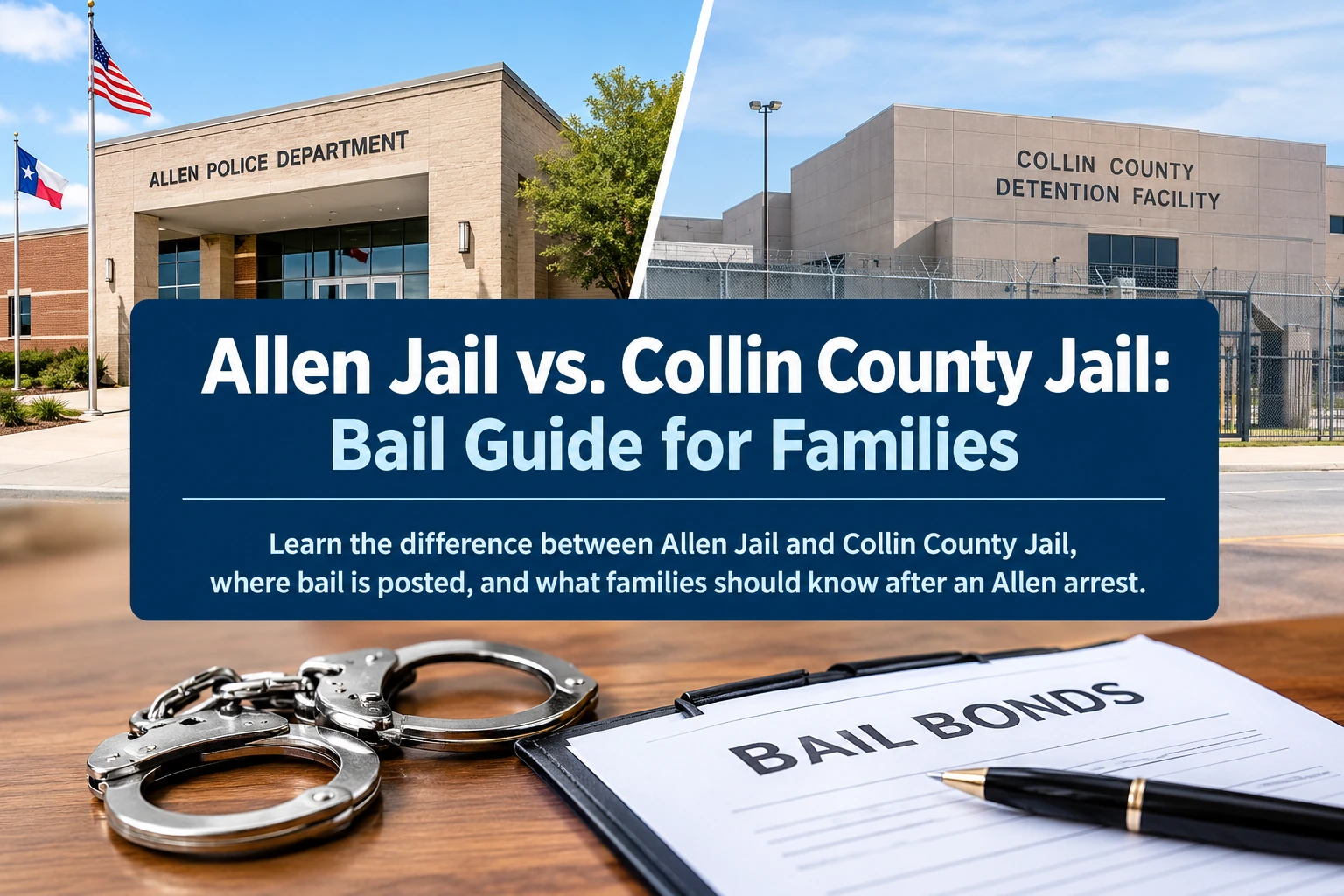
When someone is arrested in Allen, Texas, one of the first questions families usually ask is, “Where are they being held, and how do we get them out?”
The answer is not always as simple as looking for an “Allen jail” and immediately arranging a bail bond.
An arrest in Allen can involve local law enforcement, municipal court processes, and the broader Collin County criminal justice system. Where someone is being held, which court has jurisdiction, whether there are additional holds, and what type of bond has been ordered can all affect what happens next.
Understanding the difference between an Allen jail and the Collin County Detention Facility can help families avoid unnecessary delays when trying to arrange a release.
Is There a Difference Between Allen Jail and Collin County Jail?
Yes.
An arrest made in Allen may initially involve the Allen Police Department and local municipal processes. The Collin County Detention Facility, on the other hand, is operated by the Collin County Sheriff’s Office and serves as the county detention facility.
These are not simply two names for the same jail.
The important issue for a family is determining where the person is currently being held and which authority is responsible for the bond.
Collin County’s Sheriff’s Office states that bonds for inmates at the Collin County Detention Facility can be posted at the Sheriff’s Office at 4300 Community Avenue in McKinney. The county accepts cash and surety bonds there, and its Bonds Office operates 24 hours a day for bond posting.
For someone arrested in Allen, however, families should first confirm the person’s current custody location rather than assuming the person has already been transferred to the county facility.
What Happens After an Arrest in Allen, Texas?
After an arrest, the person goes through a booking and processing procedure. The exact process can vary depending on the circumstances of the arrest, the alleged offense, the agency involved, and the applicable court.
Families should gather several pieces of information as soon as possible:
- The person’s full legal name
- Date of birth
- Arresting agency
- Current detention facility
- Booking information, if available
- Charges
- Bond amount, if already set
- Court information
- Any known warrants or additional holds
Having accurate information can make it much easier to determine what needs to happen next.
This is particularly important because an arrest in Allen does not necessarily mean the person will remain at the same location throughout the entire booking and release process.
Where Is the Collin County Detention Facility?
The Collin County Detention Facility is located at:
4300 Community Avenue
McKinney, TX 75071
According to the Collin County Sheriff’s Office, cash and surety bonds for inmates at the county detention facility can be posted at this location.
The county also provides an online judicial search system that allows the public to look up information about current inmates, bond amounts, active warrants, and criminal cases.
For families trying to arrange a bail bond, checking the most current information is important because custody status and bond information can change.
How Does Bail Work for Someone Arrested in Allen?
Bail is intended to secure a defendant’s appearance in court while allowing the person to be released from custody under the applicable conditions.
The type of bond can vary.
Collin County identifies several types of bonds, including:
Surety Bond
A surety bond is posted through an approved bonding company.
Instead of paying the entire bond amount directly to the court or detention facility, the defendant or another responsible party works with a licensed bonding company to arrange the bond.
The bonding company charges a fee for its services. Collin County notes that money paid to a bonding company for its services is not refundable after the case is disposed.
For families who do not have the full amount of a cash bond available, a surety bond may provide another way to arrange release.
Cash Bond
A cash bond involves paying the full bond amount.
Collin County states that cash bonds may be paid using cash, a money order, or a cashier’s check, subject to the county’s requirements.
The county also explains that, after the case is disposed and the defendant has appeared in court as scheduled, the court can issue a refund of the cash bond.
Families should understand that a cash bond and a surety bond work differently, particularly regarding how money is paid and what happens to those funds later.
Personal Bond
A personal bond, sometimes called a personal recognizance bond, is based on the defendant’s promise to appear in court.
No traditional financial security is required in the same way as a cash or surety bond. Eligibility and approval depend on the circumstances and the applicable decision-making authority.
Pretrial Release Bond
Collin County also describes pretrial release bonds for eligible inmates.
The county’s Pretrial Department determines whether an inmate meets the applicable criteria, while approval of a pretrial bond must come from a judge.
Because not every person arrested in Allen will qualify for every type of release, families should confirm what type of bond has actually been authorized in the individual case.
Can You Use a Bail Bonds Company for an Allen Arrest?
Potentially, but the first step is confirming the person’s custody location and bond information.
If the person is being held at the Collin County Detention Facility and a surety bond is permitted, the bond can be posted through an approved Collin County bonding company.
Collin County maintains a Bail Bond Board and publishes information concerning approved bonding companies and the regulation of bail bond services in the county.
This is important because families should work with a properly authorized bail bond company rather than choosing a company solely because it appears in an online advertisement.
Before starting the process, ask the bondsman to confirm:
- Where the defendant is currently being held.
- The current bond amount.
- The charges associated with the bond.
- Whether there are additional holds.
- What information is required from the co-signer.
- What fees or costs apply.
- What responsibilities the co-signer will have.
- What happens if the defendant fails to appear in court.
Getting these answers upfront can prevent confusion later.
What If the Person Is Still at an Allen Facility?
If someone has recently been arrested in Allen, do not automatically assume that a Collin County Detention Facility bond is immediately available.
The family should first determine whether the person has completed the necessary booking process and where the person is currently being held.
The arresting agency may be the appropriate starting point for confirming custody information.
Collin County also advises that police records should be obtained from the law enforcement agency that made or took the report. The county specifically identifies local agencies such as the Allen Police Department among the agencies families may need to contact for police-related records.
This distinction matters because police records, jail custody information, court records, and bond information are not necessarily handled by the same office.
What If Someone Has Been Transferred to Collin County Jail?
If the person has been transferred to the Collin County Detention Facility, the next step is to verify the current inmate and bond information.
Collin County’s online judicial search system allows users to search for current inmates and view information that can include bond amounts and related criminal case information.
Once the bond information is confirmed, the family can determine whether a cash bond, surety bond, personal bond, or another release option applies.
If a surety bond is appropriate, the family can contact an approved Collin County bail bond company to begin the process.
Why Can Release Take Time After Bail Is Posted?
One common misunderstanding is that posting bail automatically means the defendant walks out of the facility immediately.
Release still involves jail processing.
There may be paperwork, verification, processing, identification procedures, holds, or other issues that must be addressed before release is completed.
If the defendant has another warrant, another case, or a separate hold, posting one bond may not resolve every reason the person is being held.
That is why families should ask whether any additional holds or cases need to be addressed.
A bail bond company can help explain the bond process, but the jail or appropriate government agency controls the actual release process.
What Information Should Families Have Ready?
When contacting a bail bonds company about an Allen arrest, having accurate information available can make the conversation much more efficient.
Try to have:
- Defendant’s full name
- Date of birth
- Current location
- Arrest date
- Arresting agency
- Booking number, if available
- Charge information
- Bond amount
- Court information
- Co-signer’s identification
- Reliable contact information
If you do not know the bond amount, provide as much identifying information as possible.
A professional bondsman may be able to help you determine what information is still needed before the bond can be arranged.
What Does a Co-Signer Need to Know?
A co-signer should understand that signing a bail bond is a financial and legal responsibility.
Before signing anything, ask the bonding company to explain the agreement in plain language.
The co-signer should understand:
- The amount of the bond
- The fees being charged
- Any collateral requirements
- The defendant’s court obligations
- What happens if the defendant misses court
- What responsibilities the co-signer has
- How the bond can be affected by a violation of its terms
Do not sign an agreement simply because you are trying to get someone released quickly.
Read the agreement and ask questions about anything you do not understand.
What Happens If the Defendant Misses Court?
Being released on bond does not eliminate the requirement to appear in court.
A defendant must follow the court’s instructions and any applicable bond conditions.
Failing to appear can create additional legal and financial consequences and can affect the bond.
For that reason, families should treat the court date as a critical part of the bail process.
After release, make sure the defendant knows:
- The next court date
- Where to appear
- What time to appear
- Any conditions associated with release
- How to contact the appropriate court if a legitimate scheduling issue arises
If there is uncertainty about a court date or case status, use official court resources or contact the appropriate court clerk.
Need Help After an Arrest in Allen, TX?
If a friend or family member has been arrested in Allen, Texas, knowing where the person is being held and what type of bond has been set is an important first step. Our team can explain the general Allen and Collin County bail bond process, including the difference between a surety bond, cash bond, personal bond, and other available release options.
Trying to understand what happens after an Allen arrest?
- Allen Jail Bail Information – learn what families should verify about the person’s current custody location, charges, and bond before arranging release.
- Collin County Bail Bond Process – understand how a surety bond, cash bond, personal bond, or pretrial release may differ.
- Allen Arrest & Collin County Jail – understand what families should know when someone arrested in Allen is being processed or transferred within the county system.
- Where to Post Bail in Collin County – get general information about the bond process when someone is being held at the Collin County Detention Facility.
- Jail Release After Posting Bond – learn why release may not happen immediately after a Collin County bail bond has been submitted and accepted.
Allen Jail vs. Collin County Jail: What Is the Main Difference?
The simplest way to understand the difference is this:
An Allen arrest concerns a local arrest and may involve Allen’s municipal or law-enforcement system, while the Collin County Detention Facility is the county detention facility operated by the Collin County Sheriff’s Office.
The two should not be treated as interchangeable.
For families, the most important questions are:
Where is the person right now?
Who has custody of the person?
Has a bond been set?
Which authority must approve or process the bond?
Are there any additional holds?
Once those questions are answered, arranging the appropriate type of release becomes much easier.
How Not Guilty Bail Bonds Can Help
If your family member has been arrested in Allen or elsewhere in Collin County, the first step is getting accurate information about the defendant’s current custody status and bond.
Not Guilty Bail Bonds can help families understand the bail bond process and determine what information is needed to begin a surety bond.
When you contact a bail bonds company, have the defendant’s full name, date of birth, and any available booking or bond information ready.
The sooner accurate information is available, the easier it is to determine the appropriate next step.
For immediate assistance with an Allen, Texas arrest, contact Not Guilty Bail Bonds to discuss the available bail bond process.
Frequently Asked Questions
Is Allen Jail the same as Collin County Jail?
No. An Allen arrest can involve local law enforcement and municipal processes, while the Collin County Detention Facility is operated by the Collin County Sheriff’s Office. Families should confirm the defendant’s current custody location before arranging a bond.
Where do you post a Collin County bail bond?
Collin County states that cash and surety bonds for inmates at the Collin County Detention Facility can be posted at the Sheriff’s Office at 4300 Community Avenue in McKinney, Texas. The county says its Bonds Office is available 24 hours a day for bond posting.
Can I use a bail bonds company after an Allen arrest?
If the defendant has a bond that can be satisfied through a surety bond, a licensed and approved bonding company may be able to arrange the bond. The exact process depends on the defendant’s custody location, bond, charges, and any additional holds.
How can I find out whether someone is in Collin County Jail?
Collin County provides an online judicial search system that can be used to search for current inmates and related case information. Families can use the official county system to verify current information.
What if the person has not been transferred to Collin County Jail?
If the person is still being processed by a local agency, first confirm the current custody location and booking status. Do not assume that a county bond can be posted before the person’s custody and bond information have been established.
Does posting bail guarantee immediate release?
No. Posting a bond begins the release process, but the detention facility still has to complete its required processing. Additional warrants, holds, paperwork, or other issues can affect when someone is released.
Is a cash bond refundable?
Collin County states that when a cash bond has been posted and the defendant has appeared in court as scheduled, the court can issue a refund after the case is disposed. Cash bonds and surety bonds have different financial arrangements.
What is a surety bond?
A surety bond is a type of bail bond posted through an approved bonding company. The bonding company charges a fee for providing the bond, and the person arranging the bond should understand the financial responsibilities and terms before signing.
What should I do if I cannot find the defendant’s bond amount?
Start by confirming the person’s full name, date of birth, arresting agency, and current custody location. Collin County’s online judicial search resources may provide current inmate and bond information when the case is within the county system.
Does an Allen arrest always result in a Collin County Jail booking?
Not necessarily. The custody location and processing procedure can depend on the circumstances of the arrest, the arresting agency, the charges, and other factors. Confirm the person’s current location rather than assuming where they are being held.
Final Thoughts
An arrest can be stressful for the defendant and their family, especially when it is unclear which jail is involved or where a bond needs to be posted.
The difference between an Allen arrest and custody at the Collin County Detention Facility is important because different agencies and courts may be involved at different stages.
Before arranging a bail bond, verify the defendant’s current location, bond amount, charges, and whether any additional holds exist.
Once those details are confirmed, a qualified Collin County bail bonds company can explain the available surety-bond process and help the family understand the next steps.
For families dealing with an arrest in Allen, having accurate information is the first step toward navigating the bail process with fewer delays and fewer surprises.
